What "Pure Soy Candles" Actually Means (And Why the Label Matters)
Updated: Sep 24
There is a shelf at almost every store now with candles that say "soy" somewhere on the label. Soy blend. Made with soy. Natural soy wax. The word is doing a lot of work, and most of the time nobody stops to ask what it actually means.
Here is the short version. A candle can legally say "soy" on it while being mostly something else. That's the part worth understanding before you spend money on one.
Pure Soy Versus a Blend
A blend mixes soy wax with paraffin or other waxes to cut costs and make the candle easier to mass-produce. It still gets to say "soy" on the label because there is some soy in there. How much? The label rarely tells you.
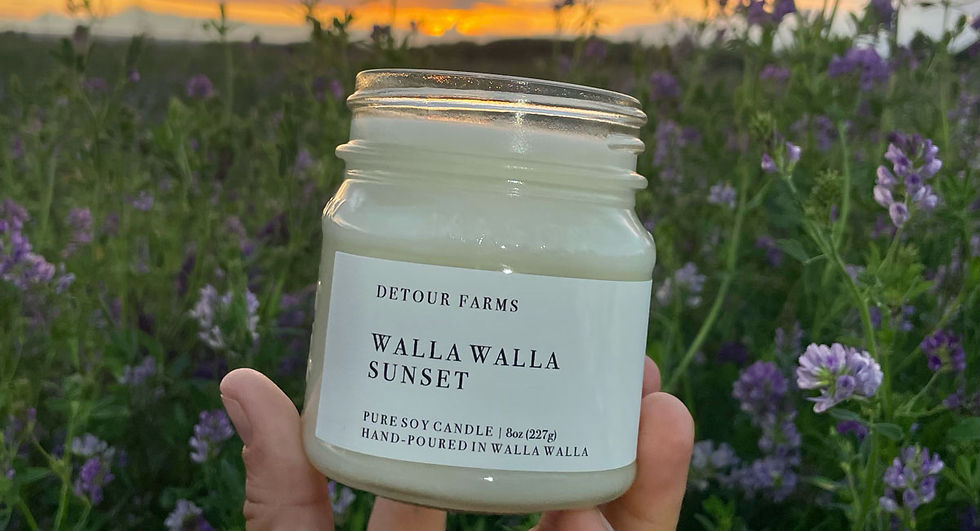
Pure soy is exactly what it sounds like. The wax is soy, full stop. Our pure soy candles are poured with 100% American made soy wax in our classic jar collection, and that's the whole point of calling them pure. No filler wax quietly making up the difference.
The reason this matters isn't marketing. It changes how the candle behaves. Blends tend to burn hotter and faster, and the paraffin portion is where a lot of the soot and heavier smoke comes from. A pure soy candle burns cooler and slower, which is a big part of why it lasts longer.

How to Read a Candle Label Without Getting Fooled
You don't need to be an expert. You just need to know what to look for.
Check the wax first. If it says "soy blend" or "soy wax blend," that's a blend. If it just says "soy" with no percentage and no other detail, ask. A maker who pours pure soy will usually tell you plainly, because it's the thing they're proud of.
Look at the wick. Ours are braided cotton, which curls slightly as it burns and helps the candle burn evenly. Cotton is a clean, reliable choice. Plenty of good makers use wood wicks too, so this isn't a cotton-or-nothing thing, but you want to know what you're getting rather than guessing from a photo.
Read the fragrance line. "Scented" tells you nothing. Scented with what? You want phthalate-free fragrance oils. Ours are premium fragrance oils infused with essential oils, non-toxic and phthalate-free. Phthalates get used to make scent hang around longer, and they're worth avoiding when you're breathing the candle in for hours at a time.
What Pure Soy Gets You Day to Day
The burn time is the first thing people notice. With proper care, ours run about 55 to 60+ hours. That's real value when you compare it against a blend in the same size jar that burns through in half the time because it's running hot.
The even burn is the second. Pure soy has what makers call memory. The first time you light it, the wax melts outward from the wick, and however far it reaches before you blow it out is the boundary it remembers. Give that first burn a full hour so the melt pool reaches the edge of the glass. Do that and you set the candle up for its whole life. Rush it and you get tunneling, that ring of wasted wax stuck to the sides.
One more thing to know: don't burn any candle longer than four hours at a stretch, and always trim the wick to a quarter inch before you light it. That's most of candle care right there.
The Scents Are Where It Gets Fun
Pure soy also holds fragrance well, which means the scents actually come through the way they were built.
A few from the current collection: Almond Macaron leads with almond and creamy amaretto over cinnamon, nutmeg, and lemon zest with a hint of vanilla. Rosemary Garden runs rosemary, green florals, sage, and cedar with hints of fir needle and eucalyptus. Milk + Fruit Loops is a fruity citrus blend that pulls straight from childhood, and it happens to be a favorite around here. Orange Grove, Linen + Lavender, Olive Tree, and Lemon Sugar round things out if you want range from bright and citrusy to soft and clean.
Every one of these is hand-poured in small batches here in Walla Walla, which is the part that lets us keep the wax pure and actually smell each batch before it goes out.
Worth Knowing Before You Buy
Pure soy costs a little more than a blend. That's honest. The wax is more expensive and the candles take longer to make. But you're getting a candle that burns longer, burns cleaner, and throws its scent more evenly, so the price per hour usually lands in your favor.
The label is the whole story. Once you know the difference between pure soy and a blend, you can't unsee it, and you stop paying blend prices for candles pretending to be more than they are.
Comments